
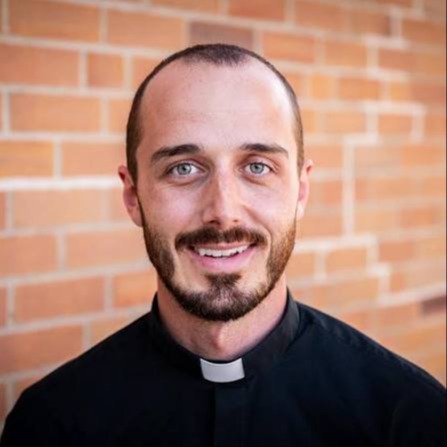
A scriptural Rosary pairs each mystery with a short Bible passage, so the beads become a slow walk through the Gospel. St. John Paul II recommended exactly this, and Advent is a natural time to try it. Fr. Ben Valentine, a priest of the Archdiocese of Dubuque, has taken the idea further with 100 Rosary mysteries drawn from the Gospel of Luke.
Key takeaways
- St. John Paul II wrote that “to recite the Rosary is nothing other than to contemplate with Mary the face of Christ” (Rosarium Virginis Mariae 3).
- He recommended following each mystery’s announcement with “a related Biblical passage, long or short” (RVM 30).
- The words of the Hail Mary come from Luke’s Gospel: Gabriel’s greeting and Elizabeth’s blessing (Luke 1:28, 42).
- The Gospel of Luke is a natural Advent companion, with the Annunciation, the Visitation and John the Baptist.
- Fr. Ben Valentine’s Advent challenge prays 100 mysteries through Luke, five a day, from November 29 to December 24, 2026.
What is a scriptural Rosary?
The Rosary has always been built on Scripture. The Our Father comes from Jesus himself, and the first half of the Hail Mary comes almost word for word from Luke’s Gospel: “Hail, favored one! The Lord is with you” (Luke 1:28) and “Most blessed are you among women, and blessed is the fruit of your womb” (Luke 1:42).
A scriptural Rosary makes that link explicit. Before each decade, or even before each Hail Mary, you read a verse or two about the mystery you are praying. The repetition stays the same, but now it rests on the words of the Bible.
Fr. Ben Valentine, parochial vicar of the Waukon Area Pastorate in northeast Iowa, put it this way on Iowa Catholic Radio’s Catholic Morning Show: “So it’s just Scripture reciting Scripture and meditating on Scripture all at once.”
What did St. John Paul II teach about praying the Rosary with Scripture?
In his 2002 apostolic letter Rosarium Virginis Mariae, St. John Paul II described the Rosary as a prayer centered on Christ. “To recite the Rosary is nothing other than to contemplate with Mary the face of Christ,” he wrote (RVM 3).
The same letter added the Luminous Mysteries, or “mysteries of light,” a meditation on “certain particularly significant moments in his public ministry” between the Joyful and Sorrowful Mysteries (RVM 19). The addition, he said, was meant “to give it fresh life and to enkindle renewed interest in the Rosary’s place within Christian spirituality.”
He also gave practical advice that is the heart of a scriptural Rosary: “In order to supply a Biblical foundation and greater depth to our meditation, it is helpful to follow the announcement of the mystery with the proclamation of a related Biblical passage, long or short, depending on the circumstances” (RVM 30). And he explained why it works: “It is not a matter of recalling information but of allowing God to speak.”
Fr. Ben said his Advent project stands on that ground. In his view, St. John Paul II opened the door to new mysteries and showed that the Rosary is meant to be a meditation on the Word of God.
How do you pray a scriptural Rosary?
You don’t need a special book to start. Here is a simple method based on the steps St. John Paul II describes in Rosarium Virginis Mariae (29–32):
- Announce the mystery. Name the moment from Christ’s life you are about to pray, such as the Annunciation.
- Read a short passage. Open your Bible, or bible.usccb.org, and read the verses for that mystery. For the Annunciation, read Luke 1:26–38.
- Pause in silence. St. John Paul II recommends a brief pause “after listening to the word of God, while the mind focuses on the content of a particular mystery” (RVM 31).
- Pray the Our Father and ten Hail Marys. Let the words become, as Fr. Ben described it, almost like background music, a steady rhythm that keeps your attention on Jesus.
- Close with the Glory Be and move to the next mystery.
If a full Rosary feels like too much, pray one decade with one passage. Fr. Ben noted that the usual Rosary takes about 20 minutes; adding meditations makes it longer, so start with what you can sustain.
Why pray the Rosary with the Gospel of Luke in Advent?
Luke’s Gospel opens with the events Advent prepares for: the Annunciation, the Visitation, the birth of John the Baptist and the birth of Jesus. Praying with Luke in December keeps the season pointed toward Christmas rather than toward the to-do list.
It also brings John the Baptist into focus. Luke presents him as the one Isaiah foretold, “A voice of one crying out in the desert: ‘Prepare the way of the Lord, make straight his paths’” (Luke 3:4). Fr. Ben pointed out that the traditional mysteries mention John only at the Baptism of the Lord, even though he is a major Advent figure. “John’s my guy,” he said, recalling John’s words in the Gospel of John: “He must increase; I must decrease” (John 3:30).
That line is a good Advent prayer on its own. Before each decade, ask for the grace to make a little more room for Christ.
Can non-Catholics pray the Rosary?
Fr. Ben hopes so. Because the Rosary is a meditation on the life of Christ in the words of Scripture, he invited non-Catholic Christians to pray along with his Advent challenge. The Hail Mary’s opening lines are Luke’s own words, and the mysteries are Gospel scenes any Christian can contemplate.
St. John Paul II wrote that “by making our own the words of the Angel Gabriel and Saint Elizabeth contained in the Hail Mary,” we are drawn to seek “the ‘blessed fruit of her womb’” (RVM 24). The focus is always Jesus.
The 100-mystery Advent Rosary challenge
Fr. Ben’s project began at the rectory table, when his pastor, Fr. Joseph Sevcik, wished out loud for 100 Rosary mysteries. After two to three months of prayer and research, Fr. Ben assembled them: the traditional 20 plus 80 new mysteries, moving through Luke with a few moments from John.
The plan, dated for Advent 2026:
- When: November 29 through December 24, 2026, five mysteries a day.
- Where: a new video each morning on his YouTube channel, Fr Ben Valentine.
- How long: about 25 to 35 minutes, with a reflection and meditation before each mystery.
- Structure: the first 20 days cover the 100 mysteries; the final days pray the Joyful Mysteries leading into Christmas.
Hear the whole conversation. Fr. Ben Valentine talks with Deacon Mark Campbell about how the 100 mysteries came together, why the Rosary is a meditation on Scripture and why John the Baptist fits Advent: listen on The Catholic Morning Show.
Start your weekday with The Catholic Morning Show, live 7–8 a.m. Central on Iowa Catholic Radio.
Listen live · Get the app for iPhone · Get the app for Android
Fr. Ben Valentine is parochial vicar of the Waukon Area Pastorate in the Archdiocese of Dubuque, where three priests serve seven parishes across Allamakee County and northern Clayton County.
Deacon Mark Campbell hosted this conversation for The Catholic Morning Show on Iowa Catholic Radio.
This article was written with AI assistance from an episode of The Catholic Morning Show, with names and facts checked against the episode’s show notes and the sources linked above.