
Christ the King Sunday, officially the Solemnity of Our Lord Jesus Christ, King of the Universe, closes the Church’s liturgical year on the Sunday before Advent. Its readings paint Jesus as a shepherd king who seeks out the lost and, at the end of time, separates the sheep from the goats according to how we treated “the least” of his brothers and sisters.
Key takeaways
- Pope Pius XI instituted the feast of Christ’s Kingship in 1925 with the encyclical Quas Primas.
- Today it is celebrated on the last Sunday of the liturgical year, right before Advent begins.
- In Ezekiel 34, God condemns shepherds who “have been pasturing themselves” and promises to shepherd his flock himself.
- In Matthew 25, the King judges the nations by works of mercy: “whatever you did for one of the least brothers of mine, you did for me.”
- St. Paul calls Christ “the firstfruits” of the resurrection and says the last enemy to be destroyed is death.
What is Christ the King Sunday?
The feast is young by Church standards. Pope Pius XI established it in his 1925 encyclical Quas Primas, writing, “We institute the Feast of the Kingship of Our Lord Jesus Christ to be observed yearly throughout the whole world.” He originally set it on the last Sunday of October, just before All Saints (Quas Primas 28).
Today the Church celebrates it as the Solemnity of Our Lord Jesus Christ, King of the Universe, on the final Sunday of the liturgical year. The next Sunday is the First Sunday of Advent, and the cycle begins again.
Pius XI noted that Christians have long given Christ the title of “King.” He reigns “in the hearts of men” because “he is very truth,” the pope wrote, and he reigns in our wills because his human will was perfectly obedient to the Father (Quas Primas 7).
On Iowa Catholic Radio’s Catholic Morning Show, host Bo Bonner called the feast “the crown of the entire liturgical year.”
What does Ezekiel 34 say about bad shepherds?
The first reading comes from the prophet Ezekiel, but the verses read at Mass make more sense with the opening of the chapter in view. God tells Ezekiel: “Woe to the shepherds of Israel who have been pasturing themselves! Should not shepherds pasture the flock?” (Ezekiel 34:2). The shepherds fed on the flock but did not strengthen the weak, heal the sick or seek the lost, and so the sheep “were scattered for lack of a shepherd” (34:4–5).
Deacon Randy Kiel, who previews the Sunday readings on the show each Thursday, pointed out what made this message so dangerous to deliver: many of Israel’s shepherds were kings. The prophet had to tell the powerful, in effect, “you’re only tending to yourself. You are not tending to the flock.” That took more than boldness, Deacon Randy said. It took the strength of the Lord.
Then comes the promise read on Christ the King Sunday. God himself will step in: “I myself will look after and tend my sheep… The lost I will seek out, the strayed I will bring back, the injured I will bind up, the sick I will heal” (Ezekiel 34:11, 16). And he adds a line that sets up the Gospel: “I will judge between one sheep and another, between rams and goats” (34:17).
What does the parable of the sheep and the goats mean?
In Matthew 25:31–46, Jesus describes the Son of Man coming in glory and sitting on his throne, with all the nations gathered before him. “He will separate them one from another, as a shepherd separates the sheep from the goats” (25:32).
The surprise is the standard he uses. The King does not ask about titles or accomplishments. He names concrete acts of mercy: “For I was hungry and you gave me food, I was thirsty and you gave me drink, a stranger and you welcomed me, naked and you clothed me, ill and you cared for me, in prison and you visited me” (25:35–36).
Both groups are puzzled. Neither remembers seeing the Lord in need. His answer is the heart of the feast: “Amen, I say to you, whatever you did for one of the least brothers of mine, you did for me” (25:40).
Ezekiel and Matthew fit together. The bad shepherds fed themselves and ignored the weak. The King who judges them is the Good Shepherd who goes after the lost, and he counts every act of care for “the least” as done to him.
What does the Church teach about the Last Judgment?
The Catechism of the Catholic Church quotes this same Gospel scene when it describes the end of time: Christ will come “in his glory, and all the angels with him,” and “he will separate them one from another as a shepherd separates the sheep from the goats” (CCC 1038).
The Catechism says the Last Judgment “will reveal even to its furthest consequences the good each person has done or failed to do during his earthly life” (CCC 1039), and that it “will reveal that God’s justice triumphs over all the injustices committed by his creatures and that God’s love is stronger than death” (CCC 1040).
It also explains why the Church keeps putting this scene in front of us. “The message of the Last Judgment calls men to conversion while God is still giving them ‘the acceptable time, . . . the day of salvation’” (CCC 1041). The sheep and the goats are not meant to frighten us into paralysis; they are an invitation to start living mercy now.
Why does St. Paul call Christ the “firstfruits”?
The second reading, from 1 Corinthians 15, looks to the end of history from a different angle. “But now Christ has been raised from the dead, the firstfruits of those who have fallen asleep” (15:20). In Israel, the firstfruits were the first part of the harvest, a sign that the rest was coming. Christ’s resurrection is the first sheaf; ours will follow.
Paul then describes the order of things: Christ first, then “those who belong to Christ” at his coming, and then the end, when Christ hands the kingdom over to the Father. “For he must reign until he has put all his enemies under his feet. The last enemy to be destroyed is death” (15:25–26).
Deacon Randy summed up the movement simply: we will die, and then we will live, and Christ will come again in glory, with death itself the last enemy put under his feet. In the end, everything comes back to order under the Father.
How can you live Christ the King Sunday?
A few ways to carry the feast into the week, drawn from the readings themselves:
- Pray Psalm 23. The responsorial psalm for the day is “The Lord is my shepherd.” It is the right prayer for anyone who feels scattered “when it was cloudy and dark.”
- Pick one work of mercy from Matthew 25. Feed someone, visit someone who is sick or in prison, welcome a newcomer. The King says he is present in them.
- Look at whom you shepherd. Parents, teachers, bosses, pastors and coaches all have a “flock.” Ezekiel’s question is for us too: am I feeding the flock or feeding myself?
- Get ready for Advent. The liturgical year ends by looking toward Christ’s return, and Advent opens the same way.
Deacon Randy closed his preview with the message he hears in these readings: “Fear not, for I am with you always.”
Hear the whole conversation. Deacon Randy Kiel walks through Ezekiel 34 and 1 Corinthians 15 with Bo Bonner in his weekly look at the Sunday readings: listen on The Catholic Morning Show.
Start your weekday with The Catholic Morning Show, live 7–8 a.m. Central on Iowa Catholic Radio.
Listen live · Get the app for iPhone · Get the app for Android
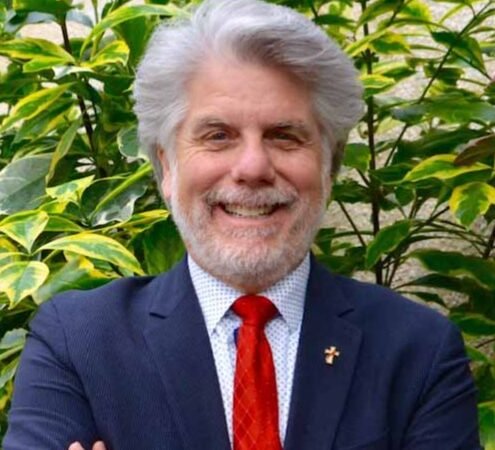
Deacon Randy Kiel joins The Catholic Morning Show every Thursday to preview the Sunday readings.
Bo Bonner hosted this conversation for The Catholic Morning Show on Iowa Catholic Radio.
This article was written with AI assistance from an episode of The Catholic Morning Show, with names and facts checked against the episode’s show notes and the sources linked above.